
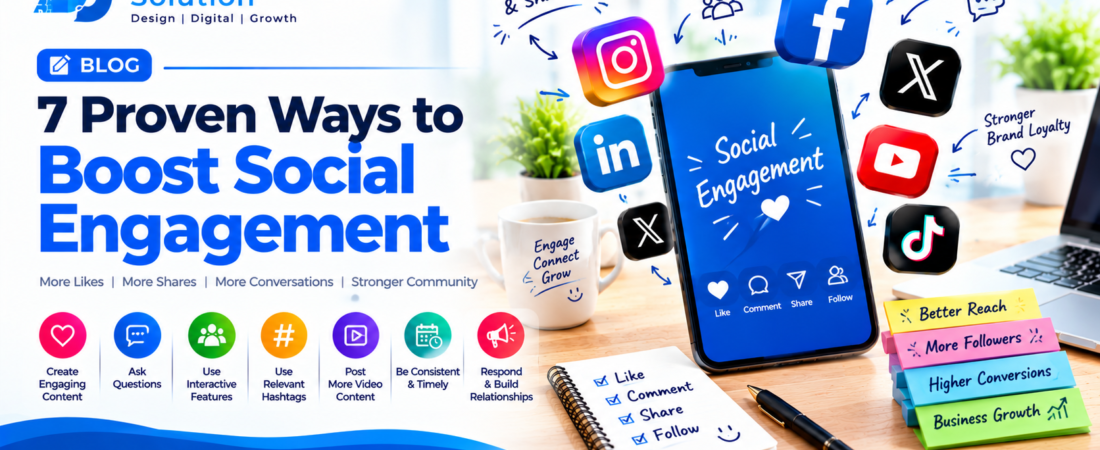
Discover 7 proven ways to boost social engagement, increase comments and shares, build an active community, and grow your business online.
Secondary keywords
social media engagement strategies
increase social media engagement
improve social media reach
social media marketing tips
boost audience interaction
social media content strategy
Suggested category
Digital Marketing
Suggested tags
Social Media Marketing, Social Media Engagement, Content Marketing, Digital Marketing Tips, Audience Growth
2. Complete WordPress blog article
Copy the complete article below into your WordPress post editor. Use the title as your H1 and the numbered section headings as H2 headings.
7 Proven Ways to Boost Social Engagement
Social media has become an essential part of digital marketing for businesses of every size. Platforms like Instagram, Facebook, LinkedIn, and YouTube help businesses connect with potential customers, promote products, build brand awareness, and develop long-term relationships with their audiences. However, simply publishing content regularly does not guarantee that people will interact with your brand.
To achieve meaningful results, businesses need a clear strategy to boost social engagement and encourage people to like, comment, share, save, and respond to their content.
Social media engagement is more than a collection of numbers. It shows how people interact with your brand and whether your content encourages them to participate in conversations. Strong engagement can help you understand customer interests, improve your content strategy, and build a more active online community.
In this guide, we will explore seven proven ways to boost social engagement, practical examples for businesses, common mistakes to avoid, and useful tips for measuring your performance.
What Is Social Media Engagement?
Social media engagement refers to the interactions people have with your content on social media platforms. These interactions can include likes, comments, shares, saves, replies, mentions, link clicks, and other platform-specific actions.
For example, if a business publishes a helpful Instagram post and followers comment with questions, share it with friends, or save it for later, those actions demonstrate engagement.
Different platforms measure engagement in different ways. Therefore, businesses should focus on the metrics that match their marketing goals rather than relying on a single number.
Why Is Social Media Engagement Important?
Social media engagement helps businesses understand how their audience responds to their content. When people actively interact with your posts, you gain useful feedback about their interests, questions, preferences, and challenges.
Here are some important benefits of improving engagement:
Builds customer relationships: Responding to comments and messages helps customers feel heard and valued.
Strengthens brand awareness: Shares and mentions can introduce your business to new audiences.
Provides audience insights: Questions and reactions reveal what your followers want to learn.
Supports lead generation: Engaged users may become interested in your services, offers, or products.
Improves content planning: Engagement data helps you identify which topics and formats deserve more attention.
Encourages community growth: Consistent conversations can help turn occasional viewers into loyal followers.
Engagement alone does not guarantee sales or higher reach. Results depend on content quality, audience relevance, platform distribution, and your overall marketing strategy.
1. Create Valuable and Audience-Focused Content
One of the most effective ways to boost social engagement is to publish content that genuinely helps your target audience. People are more likely to interact with posts that answer their questions, solve problems, entertain them, or provide useful information.
Before creating a post, ask yourself: What will my audience gain from this content?
For example, a digital marketing agency can publish educational posts about online advertising, search engine optimization, website design, and social media marketing. These topics help potential customers understand digital marketing and identify opportunities to improve their businesses.
Content ideas that encourage engagement
Educational posts: Share practical tips, tutorials, and step-by-step guides.
Question-based posts: Ask followers about their experiences or preferences.
Behind-the-scenes content: Show your team, creative process, or daily business activities.
Industry insights: Explain useful trends and changes relevant to your audience.
Problem-solving posts: Address common mistakes and provide realistic solutions.
Customer stories: Share genuine customer feedback or project examples with permission.
For instance, instead of publishing only a promotional graphic saying, “We offer social media marketing services,” create a post titled “5 Social Media Mistakes Small Businesses Should Avoid.”
The second idea offers immediate value and gives readers a reason to save, comment on, or share the post.
Pro tip: Develop content around the questions your customers ask most frequently. Helpful, relevant content gives people a stronger reason to engage with your brand.
2. Use Short-Form Videos and Engaging Visuals
Visual content plays an important role in social media marketing. Short-form videos, Reels, carousels, infographics, and well-designed graphics can help businesses communicate ideas in an easy-to-understand format.
Videos are particularly useful for demonstrating products, explaining services, sharing quick tutorials, and introducing your team. However, the best format depends on your audience and the platform you use.
How to create engaging video content
Start with a strong opening. Give viewers a clear reason to continue watching. You could introduce a common problem, ask an interesting question, or promise a practical takeaway.
Keep the message focused. Explain one main idea instead of trying to cover too many topics in a single video.
Add captions. On-screen text can make videos easier to follow when people watch without sound.
Use clear visuals. Ensure that your text is readable, your audio is understandable, and your design matches your brand identity.
End with a relevant call to action. Invite viewers to share their opinions, save the tutorial, or ask a question.
For example, a website design agency could publish a short video showing five common website design mistakes. A graphics designer could demonstrate how a professional logo develops from an initial concept to a final design.
These formats educate potential customers while showcasing the business’s expertise.
Remember that video length, style, and performance vary by platform. Test different formats and review your analytics to discover what works best for your audience.
3. Ask Questions and Encourage Meaningful Conversations
Social media is not just a place to publish advertisements. It is an opportunity to start conversations with the people who follow your business.
Asking relevant questions encourages followers to share their experiences, preferences, and opinions. It also gives your business valuable information about customer needs.
For example, a digital marketing agency might ask:
Which platform brings your business the most enquiries: Instagram, Facebook, or LinkedIn?
What is your biggest challenge with social media marketing?
Would you prefer a website redesign or a stronger social media strategy?
Which topic should we explain in our next video?
These questions are simple, specific, and related to your audience’s interests.
Make your questions easy to answer
Avoid asking questions that are too broad or complicated. A simple question with two or three clear options can encourage more people to participate.
You can also use platform features such as polls, quizzes, question stickers, and interactive Stories when available.
Most importantly, respond to the answers you receive. Thank people for their feedback, answer follow-up questions, and use their suggestions to create future content.
Avoid engagement bait that pressures people into interacting without offering real value. The goal is to encourage genuine conversations, not collect meaningless comments.
4. Post Consistently at the Right Times
Consistency helps your audience know what to expect from your brand. If your business publishes content irregularly, followers may have fewer opportunities to discover your updates and interact with them.
However, posting more frequently does not automatically mean better engagement. A manageable schedule with useful content is generally more sustainable than publishing several low-quality posts every day.
Build a practical content calendar
A content calendar helps you plan topics, formats, publishing dates, and calls to action in advance.
For example, a business could follow this weekly schedule:
Monday: Educational tips or industry insights.
Tuesday: Short-form video or tutorial.
Wednesday: Customer question or interactive poll.
Thursday: Behind-the-scenes content or project showcase.
Friday: Frequently asked questions or a useful checklist.
Weekend: Community updates, customer stories, or lighter content when relevant.
This is only a sample schedule. Your ideal frequency depends on your audience, resources, and platform analytics.
How to identify the best posting times
Review the analytics available in your social media accounts. Look for patterns in audience activity, reach, interactions, and post performance.
Test different publishing times over several weeks and compare similar types of content. Do not assume that a popular general recommendation will work equally well for every business.
Use scheduling tools when they help you maintain consistency, but continue monitoring comments and messages after publishing.
5. Use Relevant Hashtags, Keywords, and Platform Features
People discover content in different ways. They may find a post through recommendations, searches, hashtags, shared links, creator profiles, or their existing network.
Using relevant keywords and platform features can make your content easier for interested users to understand and discover.
Choose hashtags carefully
Hashtags can help categorize content on platforms that support them. Select hashtags related to your subject, industry, location, or target audience.
For example, a digital marketing agency might use relevant terms such as:
#SocialMediaMarketing
#DigitalMarketing
#ContentMarketing
#SmallBusinessMarketing
#SocialMediaTips
Use only hashtags that genuinely relate to the post. Adding a large number of unrelated hashtags does not guarantee more reach or engagement.
Write clear captions and keywords
Explain the topic naturally in your caption. If you are sharing advice about social media marketing, use that phrase where it fits instead of adding keywords awkwardly.
Also make use of relevant platform features, including Stories, Reels, carousels, polls, live sessions, and collaboration posts, when they suit your goals.
For local businesses, location information can help make content more relevant to nearby customers.
The key is to make your content clear, useful, and relevant rather than trying to exploit every available feature.
6. Respond to Comments, Messages, and Mentions
Publishing content is only one part of social media management. Building relationships requires ongoing communication.
When followers comment on your posts or send messages, respond in a helpful and timely manner. A thoughtful reply can turn a simple interaction into a useful conversation and demonstrate that your business values its audience.
Best practices for community management
Reply with useful information. If someone asks about a service, provide a clear answer instead of replying with a generic emoji.
Acknowledge feedback. Thank customers who share their experiences, suggestions, or positive comments.
Answer frequently asked questions. If many people ask the same question, consider creating a dedicated post or video about it.
Handle complaints professionally. Stay calm, acknowledge the concern, and offer a practical next step. Avoid arguing publicly with customers.
Monitor mentions and direct messages. Important enquiries may arrive outside your regular posting schedule, so check your inbox consistently.
For example, if a follower asks about website development pricing, explain the factors that affect the cost and invite them to share their requirements privately if needed.
This approach helps create trust and can support future business enquiries.
Community management should be part of your overall social media strategy, not an afterthought.
7. Analyse Performance and Improve Your Strategy
The final step in learning how to boost social engagement is measuring results and using the findings to improve future content.
Without reviewing your performance, it is difficult to know whether your content is attracting the right audience or encouraging meaningful interactions.
Most major social media platforms provide analytics or insights for professional accounts. The available metrics vary by platform and account type.
Important social media engagement metrics
Engagements: The total number of interactions, such as likes, comments, shares, or saves, included in the platform’s reporting.
Engagement rate: The proportion of a defined audience or reach that interacts with your content. Always state which denominator you use.
Reach: The number of unique accounts or people who saw your content, as defined by the platform.
Shares: The number of times users shared your content, where reported.
Saves: The number of times users saved your content, where reported.
Comments and replies: Useful indicators of conversation and audience feedback.
Link clicks: Helpful for understanding whether social content drives visitors to your website or landing page.
One common calculation is:
Engagement rate by reach = (Total engagements ÷ Total reach) × 100
For example, if a post receives 80 engagements and reaches 2,000 accounts, its engagement rate by reach is 4%.
This calculation is useful for comparison, but platforms may define engagement and reach differently. Use consistent definitions when comparing results.
How to improve based on analytics
Review your strongest and weakest posts regularly. Compare content formats, topics, publishing times, calls to action, and audience responses.
If educational carousels consistently attract saves, create more useful guides. If videos receive strong views but few meaningful interactions, experiment with clearer messages and more relevant calls to action.
Avoid judging success by likes alone. A post that generates qualified enquiries or meaningful customer conversations may be more valuable to your business than one that receives many superficial reactions.
Use your findings to improve your next content calendar and continue testing new ideas.
Common Mistakes That Reduce Social Media Engagement
Even businesses that publish frequently can struggle with engagement if their strategy is not audience-focused.
Avoid these common mistakes:
Posting only promotional content: Constant sales messages can make your account less useful to followers. Balance promotions with education, entertainment, and community content.
Ignoring comments and messages: Leaving genuine questions unanswered can weaken customer relationships.
Using irrelevant hashtags: Unrelated hashtags can confuse your audience and make your content less focused.
Copying competitors: Learn from other businesses, but create original content that reflects your own expertise and brand.
Buying fake followers or engagement: Artificial interactions do not provide reliable insight into customer interest and can undermine your marketing efforts.
Publishing without a strategy: Random posts may not support your business goals or provide a consistent experience.
Ignoring analytics: Without performance reviews, you may repeat ineffective approaches instead of learning from results.
Focus on genuine audience relationships, useful content, and steady improvement rather than shortcuts.
How SJ Digi.Tech Solution Can Help Your Business
Managing social media effectively takes planning, creativity, consistency, and performance analysis. Businesses often need support to develop a content strategy, create professional visuals, manage community interactions, and connect social media activity with wider marketing goals.
SJ Digi.Tech Solution helps businesses strengthen their digital presence through services such as:
Social media marketing and account management
Social media content planning and creative design
Meta advertising on Facebook and Instagram
Google Ads campaign management
Website design and development
Lead generation and performance marketing
A well-planned strategy can help your business communicate more consistently, understand its audience, and work toward measurable marketing objectives.
If you want to improve your social media presence, consider reviewing your current content, audience engagement, and campaign performance before deciding which activities to prioritise.
Frequently Asked Questions (FAQs)
1. What is the best way to boost social engagement?
Start by creating relevant content that solves audience problems or answers common questions. Combine this with interactive posts, consistent publishing, thoughtful replies, and regular performance reviews. The best approach depends on your audience and platform.
2. How often should a business post on social media?
There is no single posting frequency that works for every business. Begin with a schedule you can maintain without sacrificing content quality. Review analytics and adjust your frequency based on audience response and available resources.
3. Which social media platform is best for engagement?
The best platform depends on your target audience, industry, content format, and business goals. Instagram and Facebook may suit many consumer-focused businesses, while LinkedIn can be useful for business-to-business marketing. Test relevant platforms and compare meaningful results.
4. Do hashtags increase social media engagement?
Relevant hashtags may help categorize content and support discovery on certain platforms. However, hashtags alone do not guarantee engagement. Content quality, relevance, audience interest, and platform-specific factors also matter.
5. How can small businesses increase engagement without paid ads?
Small businesses can publish educational content, answer customer questions, use interactive features, participate in relevant conversations, collaborate with suitable creators, and respond to comments. Organic growth takes consistency and may vary depending on the market and platform.
6. How do I measure social media engagement?
Track metrics such as comments, shares, saves, total engagements, engagement rate, reach, and link clicks. Choose metrics that match your objectives and use consistent definitions when comparing posts over time.
7. Can social media engagement help generate leads?
Yes. Meaningful engagement can help businesses build awareness, answer customer questions, and develop trust. To generate leads, combine useful content with a relevant offer, a clear call to action, and an effective landing page or enquiry process.
Conclusion
Learning how to boost social engagement requires more than publishing posts and hoping for likes. Businesses need to understand their audiences, share useful content, encourage conversations, maintain a consistent schedule, use relevant platform features, respond to followers, and analyse performance.
The seven strategies in this guide provide a practical starting point for building stronger social media relationships. Begin with two or three improvements, track their results, and refine your approach as you learn what your audience values.
For businesses looking to strengthen their digital presence, SJ Digi.Tech Solution can help bring content planning, social media marketing, advertising, and website development together as part of a coordinated strategy.
Ready to improve your social media marketing? Review your current strategy, identify your biggest engagement challenge, and take the next step toward building a more active online community.
3. Featured image SEO
Recommended featured image
Suggested dimensions: 1200 × 675 px
File name
7-proven-ways-boost-social-engagement.webp
Image alt text
7 proven ways to boost social engagement
Image title
7 Proven Ways to Boost Social Engagement
Use a compressed WebP image where possible to help page performance. Write alt text that accurately describes the image, rather than adding unrelated keywords.
4. Internal linking strategy
Add relevant links to existing pages on your website to help readers discover related services and content.
Suggested anchor text | Link to your website page |
|---|---|
Social media marketing services | Social Media Marketing |
Meta Ads management | Meta Ads Services |
Google Ads services | Google Ads Services |
Professional graphic design | Graphic Design Services |
Website design and development | Website Design |
Lead generation strategies | Lead Generation Services |
Replace these page names with the actual URLs on your WordPress website. Only link to pages that exist and are relevant to the sentence.
5. Rank Math SEO checklist
Pre-publishing checklist
1 of 10
Important SEO note: Rank Math helps you check on-page SEO elements, but a high plugin score does not guarantee Google rankings. Google recommends helpful, reliable, people-first content rather than writing solely to satisfy an SEO checklist.
For the best result, review the article for your business’s real expertise, add relevant links, and update it when your services or recommendations change.
⋮⋮⋮⋮
⋮⋮⋮⋮