
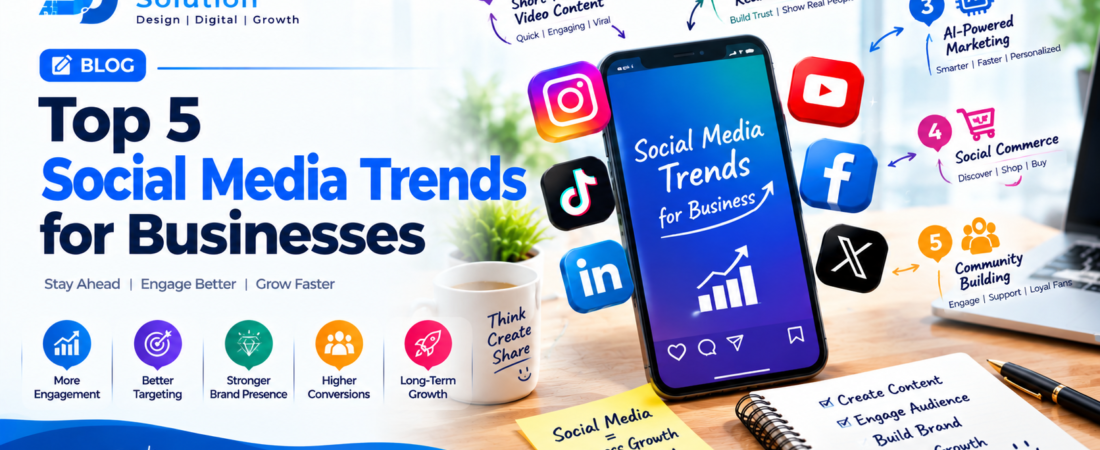
Top 5 Social Media Trends for Businesses in 2026
Social media is constantly changing, creating new opportunities for businesses to connect with customers, build brand awareness, and promote their products and services. What worked a few years ago may not deliver the same results today. Businesses need to understand changing audience behaviour, content formats, and platform features to keep their marketing relevant.
In 2026, businesses are paying attention to short-form video, artificial intelligence (AI), social media search, creator partnerships, and online communities. These developments can help brands communicate more effectively, reach relevant audiences, and build stronger customer relationships.
However, following every new trend is not a successful marketing strategy. The right approach is to choose trends that match your audience, business goals, available resources, and brand identity.
In this guide, we explore the top 5 social media trends for businesses in 2026, explain why they matter, and share practical ways to use them in your digital marketing strategy.
Why Should Businesses Follow Social Media Trends?
Social media trends reflect changes in how people discover content, communicate with brands, and make purchasing decisions. Understanding these changes can help businesses plan more relevant content and use their marketing resources effectively.
Here are some important benefits of following relevant social media trends:
Improve brand visibility: Reach people through content formats and platforms they actively use.
Increase audience engagement: Share content that answers questions, entertains, or solves problems.
Build customer trust: Communicate with people in a more useful and authentic way.
Support lead generation: Guide interested audiences toward your website, enquiry form, or services.
Improve marketing efficiency: Use insights and suitable tools to plan, create, and measure content.
Not every trend will suit every business. A B2B company may benefit more from professional insights on LinkedIn, while a consumer brand may prioritise Instagram Reels or creator collaborations. The goal is to apply trends strategically rather than copy competitors.
1. Short-Form Video Marketing Continues to Grow
Short-form video remains an important format for businesses using social media. Instagram Reels, YouTube Shorts, and TikTok videos give brands opportunities to explain ideas, demonstrate products, share quick tips, and introduce their personality in a concise format.
Videos can help communicate information quickly and make complex topics easier to understand. They also provide an opportunity to show the people, process, and expertise behind a business.
However, successful video marketing does not require expensive equipment or elaborate production. Clear information, relevant storytelling, good sound, and a strong opening can be more important than creating a highly polished video.
How Businesses Can Use Short-Form Videos
Create educational videos: Explain a common customer problem and offer a practical solution.
Show products or services in action: Demonstrate how a product works or explain the process behind a service.
Answer frequently asked questions: Turn common customer enquiries into short videos.
Share behind-the-scenes content: Show your team, workspace, preparation, or creative process where appropriate.
Use customer stories: Share genuine testimonials or experiences with permission and without exaggerating results.
Repurpose existing content: Convert useful blog articles, webinars, and presentations into shorter video topics.
Example for a Digital Marketing Agency
SJ Digi.Tech Solution could create a short video explaining three common mistakes businesses make when running social media campaigns. Another video could demonstrate how a content calendar helps maintain consistency.
Each video should focus on one clear idea and end with a relevant next step, such as visiting a service page or reading a related article.
Best Practices for Video Marketing
Capture attention early by clearly introducing the topic.
Use captions when they improve accessibility and understanding.
Keep the message focused on one main idea.
Use vertical video when appropriate for the platform.
Add a clear call to action when relevant.
Review watch time, audience retention, shares, clicks, and enquiries.
Key takeaway: Use short-form video to educate and connect with your audience. Focus on usefulness and consistency instead of chasing viral views.
2. AI-Assisted Content Creation and Personalisation
Artificial intelligence is changing how businesses plan, draft, organise, and analyse social media content. AI-powered tools can assist with brainstorming, caption drafts, content calendars, creative variations, audience research, and reporting.
For small businesses with limited marketing resources, AI can help speed up parts of the content workflow. However, it should support human judgement rather than replace it.
AI-generated content may contain inaccurate information, generic language, or ideas that do not reflect your brand. Human review is essential before publishing.
How Businesses Can Use AI in Social Media Marketing
Generate content ideas: Use AI to brainstorm topics based on your audience’s questions and business objectives.
Draft captions: Create an initial caption and then edit it to match your brand voice.
Plan content calendars: Organise topics into educational, promotional, engagement, and trust-building categories.
Repurpose content: Turn a blog post into a series of social media captions, short-video outlines, or carousel concepts.
Explore creative variations: Develop alternative headlines, calls to action, or design directions for testing.
Analyse performance: Use suitable analytics tools to identify patterns in engagement and campaign results.
Example
A digital marketing agency could use AI to brainstorm a month’s worth of social media topics. The team can then select the most relevant ideas, verify any factual claims, add real business insights, and create original graphics or videos.
This approach combines speed with human expertise.
How to Use AI Responsibly
Check facts and statistics before publishing.
Edit drafts to sound natural and specific to your brand.
Avoid inventing customer testimonials, case studies, or results.
Protect confidential customer and business information.
Respect copyright, privacy, and platform policies.
Use genuine images and disclose synthetic or AI-generated content when required by applicable rules or context.
Key takeaway: AI is most useful when it improves your workflow while preserving originality, accuracy, and the human character of your brand.
3. Social Search Is Becoming More Important
People do not rely only on traditional search engines to discover businesses and learn about products. Many users also search directly within social media platforms for tutorials, reviews, recommendations, demonstrations, and local business information.
This makes social search an important consideration for businesses that want their content to be discoverable.
For example, someone might search Instagram for design inspiration, YouTube for a product tutorial, or TikTok for a quick explanation of a topic. The exact behaviour varies by audience and platform.
How to Optimise Social Media Content for Search
Use descriptive captions: Explain what the content covers instead of relying on vague or overly promotional text.
Include relevant keywords naturally: Use the phrases your audience is likely to search for, where they fit the content.
Create searchable video titles: Give YouTube videos and other supported content clear, accurate titles.
Answer specific questions: Create posts around common customer problems, comparisons, and frequently asked questions.
Optimise your business profile: Keep your business description, service information, website link, and contact details accurate.
Add useful context to visuals: Use readable text in graphics and relevant captions to help people understand the subject.
Encourage genuine customer reviews: Where a platform supports reviews, invite honest feedback without offering inappropriate incentives or manipulating ratings.
Example for a Local Business
A website design company serving businesses in Pune could publish a guide about choosing a business website designer, create a video about mobile-friendly websites, and share a checklist for preparing website content.
These pieces answer real questions and may help interested business owners discover the company.
Social Search and Website SEO
Social media search and website SEO can support each other, but they are not the same. Social platforms have their own discovery systems, while Google uses its own methods to understand and rank web pages.
A practical strategy is to publish helpful social content and link to relevant, detailed website resources when appropriate. Your website can provide additional information, examples, service details, and a clear way to enquire.
Key takeaway: Make your social content easy to understand and discover. Write for real customer questions rather than filling captions with repetitive keywords or hashtags.
4. Creator Partnerships and Authentic User-Generated Content
Audiences often want to see how products and services work in real situations. Creator collaborations and user-generated content can help businesses show their offerings through people, experiences, and perspectives beyond their official brand accounts.
Creator partnerships involve working with relevant content creators, experts, or influencers. User-generated content, often called UGC, is content created by customers or users about a brand, product, or experience.
These approaches can help introduce a business to new audiences, provide different perspectives, and create opportunities for more relatable storytelling.
How Businesses Can Use Creator Marketing
Choose relevant creators: Look for people whose content and audience match your target customers.
Review content quality: Assess whether the creator communicates clearly and has an authentic relationship with their audience.
Set clear expectations: Agree on deliverables, timelines, compensation, usage rights, and campaign objectives.
Allow authentic storytelling: Provide accurate product information and brand guidelines while allowing the creator to use their own voice.
Measure business outcomes: Track relevant reach, engagement, referral traffic, enquiries, or conversions.
How to Encourage User-Generated Content
Ask satisfied customers for honest feedback.
Invite customers to share their experience, where appropriate.
Request permission before reposting their photos, videos, or comments.
Credit creators according to the agreed terms and platform practices.
Avoid editing testimonials in ways that change their meaning.
Follow applicable advertising disclosure and privacy requirements.