
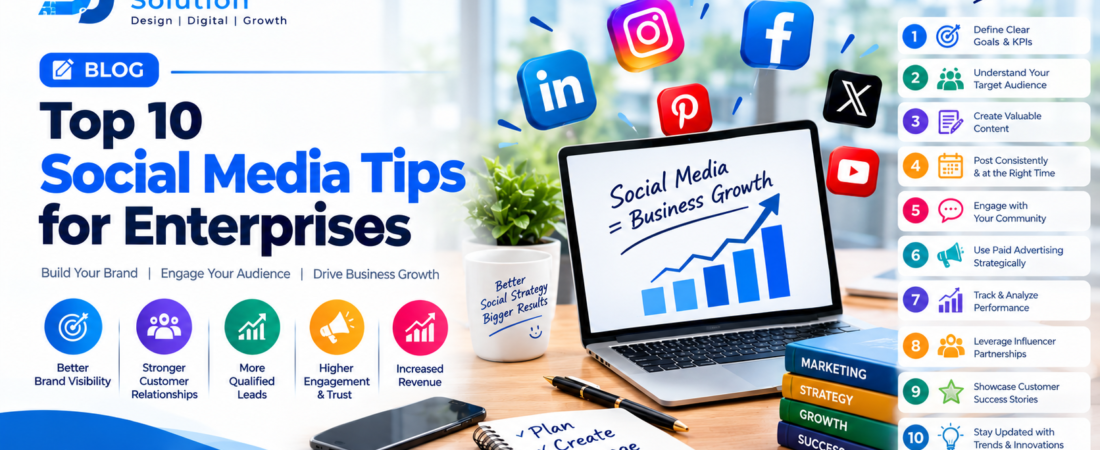
Top 10 Social Media Tips for Enterprises
This article is prepared for your WordPress website, with enterprise-focused social media advice, Rank Math SEO settings, practical examples, FAQs, and internal-link recommendations for SJ Digi.Tech Solution.
The goal is to help business owners and marketing teams build a stronger social media presence while creating content that is useful to readers and aligned with search engine best practices. Google recommends prioritising helpful, people-first content rather than targeting a particular word count alone.
1. Rank Math SEO settings
Top 10 Social Media Tips for Enterprises: A Complete Guide
Top 10 Social Media Tips for Enterprises
social media tips for enterprises
enterprise social media strategy
social media marketing for enterprises
enterprise social media management
business social media tips
social media analytics
Discover 10 social media tips for enterprises to strengthen brand awareness, improve engagement, manage content, generate leads, and measure results.
social-media-tips-for-enterprises
Digital Marketing
Enterprise Marketing, Social Media Strategy, Digital Marketing, Brand Awareness, Social Media Management
Enter these details in the Rank Math SEO panel inside your WordPress post editor. The suggested settings are a starting point; confirm the final preview and any keyword checks in your installed plugin version.
2. Complete blog article — ready to publish
Top 10 Social Media Tips for Enterprises: A Complete Guide
Social media has become an important communication and marketing channel for enterprises. Large businesses use social platforms to build brand awareness, communicate with customers, promote products and services, and maintain relationships with different audiences.
However, managing social media for an enterprise is more complex than publishing regular posts. Large organisations often manage multiple brands, departments, locations, customer groups, and marketing campaigns. Without a clear strategy, their social media activities can become inconsistent, difficult to measure, and disconnected from business objectives.
Following the right social media tips for enterprises can help organisations improve their online presence, deliver consistent brand messaging, engage customers, and make better marketing decisions.
In this guide, SJ Digi.Tech Solution shares ten practical social media tips that enterprises can use to strengthen their digital marketing strategy and achieve measurable business outcomes.
Why Is Social Media Important for Enterprises?
Social media enables enterprises to communicate directly with customers, share business updates, demonstrate expertise, and receive feedback. It also provides opportunities to distribute educational content, support product launches, and develop relationships with industry communities.
A well-managed social media presence can support several business objectives:
Increasing brand awareness across relevant markets.
Strengthening customer engagement and loyalty.
Promoting products, services, and campaigns.
Supporting website traffic and lead generation.
Improving customer communication.
Gathering audience insights and feedback.
Measuring marketing performance.
Enterprises should not measure success only by followers or likes. Their social media strategy should connect with wider objectives, such as customer satisfaction, qualified enquiries, brand recognition, and revenue opportunities.
Top 10 Social Media Tips for Enterprises
1. Develop a Clear Enterprise Social Media Strategy
The first step is to create a documented social media strategy that supports your organisation’s business goals.
Enterprises may have several departments managing marketing, customer service, recruitment, communications, and sales. If these teams publish content independently without coordination, the brand can appear inconsistent.
A shared strategy helps everyone understand the organisation’s objectives, target audiences, responsibilities, and communication standards.
Start by defining your main goals. These may include improving brand awareness, increasing customer engagement, generating leads, promoting new products, or strengthening customer relationships.
Next, identify the audiences you want to reach. An enterprise may communicate with existing customers, potential buyers, business partners, employees, and industry professionals. Each group may require different messaging and content.
Your strategy should also define the platforms you will use, the content you will publish, the resources available, and the metrics you will track.
Practical tip: Create a one-page social media strategy that documents your goals, audience segments, priority platforms, content themes, budget, responsibilities, and reporting schedule.
Review the strategy regularly so it remains aligned with business priorities and changing customer needs.
2. Understand Your Target Audience
Effective social media marketing begins with understanding the people you want to reach.
Enterprises often serve multiple customer segments across different industries, locations, and stages of the buying journey. Publishing the same message to everyone may reduce its relevance.
Develop audience profiles based on reliable information, such as customer research, sales feedback, website analytics, and previous campaign performance.
Consider these factors:
Customer needs and challenges.
Industry and professional role.
Geographic location and language.
Preferred content formats.
Common questions and objections.
Purchasing behaviour and decision-making process.
For example, a business selling enterprise software may need detailed educational content for decision-makers, while existing customers may prefer product updates, tutorials, and support information.
Audience research can also help you choose appropriate platforms. LinkedIn may be useful for professional and B2B communication, while Instagram and Facebook may be suitable for visual campaigns and consumer engagement, depending on the business.
Practical tip: Review customer questions and feedback every month. Use recurring themes to create relevant posts, videos, articles, and campaign messages.
Always handle customer information responsibly and use appropriate consent and privacy practices when collecting or using personal data.
3. Maintain Consistent Brand Identity Across Platforms
Brand consistency is especially important for enterprises that operate multiple accounts, departments, or regional pages.
Customers should be able to recognise your organisation regardless of which social platform they use.
Establish clear brand guidelines that explain how the organisation should communicate online. These guidelines may cover logos, colours, typography, tone of voice, image styles, approved descriptions, and messaging standards.
Consistency does not mean publishing identical content everywhere. Each platform has its own audience expectations and content formats. Instead, adapt the presentation while maintaining the same brand identity and core message.
For example, an enterprise can publish a detailed industry article on LinkedIn, a short educational video on Instagram, and a longer product demonstration on YouTube.
All three pieces of content can communicate the same underlying message while being tailored to their respective platforms.
Maintain accurate profile information, website links, contact details, and descriptions across all official accounts.
Practical tip: Create a central brand asset library containing approved logos, templates, photographs, video assets, and brand guidelines. Make it accessible to authorised team members.
Consistent branding improves recognition and helps customers develop a clearer understanding of your organisation.
4. Create Valuable and Audience-Focused Content
Content is one of the most important parts of enterprise social media marketing.
Rather than publishing only promotional announcements, enterprises should provide information that helps their audiences understand industry developments, solve problems, evaluate products, and make informed decisions.
Useful content categories include:
Educational posts and industry insights.
Product demonstrations and tutorials.
Company announcements and updates.
Customer stories and case studies.
Frequently asked questions.
Employee expertise and behind-the-scenes content.
Event announcements and highlights.
Relevant offers and campaign promotions.
For example, a technology enterprise can publish cybersecurity awareness tips, software tutorials, product updates, and customer education resources.
A professional services organisation may share industry analysis, practical guides, and answers to common customer questions.
Maintain accuracy when publishing statistics, testimonials, product claims, and customer results. Obtain permission before sharing confidential or identifiable customer information.
Use a mix of text, images, short videos, carousels, and longer educational content where suitable.
Practical tip: Organise your content into three categories: educational, trust-building, and promotional. This makes it easier to maintain a balanced publishing schedule.
5. Use a Social Media Content Calendar
A content calendar helps enterprises coordinate publishing across teams, platforms, and campaigns.
Without a central plan, organisations may publish overlapping content, miss important campaign dates, or leave their accounts inactive for extended periods.
A content calendar provides a shared view of planned posts and their responsibilities.
Include the following details:
Publication date and platform.
Content topic and campaign.
Target audience.
Caption and creative assets.
Approval status.
Publishing owner.
Call to action.
Performance metrics.
For enterprises with several departments, establish a process for submitting content requests, reviewing drafts, approving materials, and scheduling publication.
Plan major campaigns in advance while leaving room for timely updates and relevant customer conversations.
Automation and scheduling tools can reduce repetitive work, but scheduled content should still be reviewed to ensure that it remains accurate and appropriate.
Practical tip: Plan content monthly and review the calendar weekly. This creates a predictable workflow without preventing the team from responding to new opportunities.
Consistency is more important than publishing an unrealistic number of posts. Select a schedule that matches your audience, platform, and available resources.
6. Invest in Paid Social Media Advertising
Organic social media can support audience relationships, while paid advertising can help enterprises extend reach and promote specific business objectives.
Platforms such as Facebook, Instagram, and LinkedIn provide advertising options that can support awareness, traffic, lead generation, and sales objectives.
Before launching a campaign, establish a clear plan.
First, identify the campaign objective. A brand awareness campaign requires a different approach from a lead-generation campaign.
Next, define the intended audience, creative assets, offer, landing page, budget, and measurement method.
Enterprises should also consider how paid campaigns fit into their wider marketing activities. For example, social advertising can promote an educational resource, while a follow-up email or sales process can help convert interested prospects.
Test different creative concepts and messages systematically. Monitor campaign spending, lead quality, and conversion performance before making decisions about scaling.
Avoid evaluating advertising solely through impressions or clicks. A campaign that attracts a large audience may still underperform if the audience is not relevant.
Practical tip: Establish clear campaign reporting before launch. Track relevant outcomes, such as qualified leads, conversion rate, cost per acquisition, and attributed revenue where reliable measurement is available.
Paid advertising works best when it is connected to a clear business objective and supported by an effective landing page and follow-up process.
7. Encourage Customer Engagement and Community Building
Social media is a two-way communication channel. Enterprises should use it to listen to customers, answer questions, and build meaningful relationships.
Simply publishing content without responding to the audience can create a disconnected experience.
Develop an engagement process that explains who is responsible for comments, messages, complaints, and customer questions.
Your team should aim to:
Respond to genuine questions clearly.
Acknowledge positive feedback.
Address complaints professionally.
Share useful information when customers need help.
Identify recurring concerns.
Escalate sensitive issues to the appropriate department.
Maintain a respectful and consistent brand voice.
For enterprises, coordination between marketing and customer service is particularly important. A social media complaint may require support from a service team, account manager, or product specialist.
Establish response guidelines and realistic service expectations. Avoid making promises that the organisation cannot fulfil.
Customer conversations can also provide valuable feedback about product features, service quality, and communication problems.
Practical tip: Maintain an internal record of recurring customer questions and complaints. Use the findings to improve customer support and develop more helpful content.
8. Use Video and Visual Storytelling
Visual content can help enterprises explain complex ideas, demonstrate products, and communicate their brand personality.
Short videos, demonstrations, interviews, infographics, and presentations can make information easier to understand when they are relevant to the audience.
Choose the format according to the message rather than using video simply because it is popular.
For example, an enterprise can use a short video to introduce a new service, a tutorial to explain a product feature, or an employee interview to share specialist knowledge.
Effective visual content should have a clear purpose, understandable messaging, and professional presentation.
Consider these practices:
Capture attention with a relevant opening.
Focus on one main idea.
Use readable captions where appropriate.
Maintain brand consistency.
Ensure audio and visuals are clear.
Add subtitles when useful for accessibility.
Include an appropriate call to action.
Review performance to understand audience response.
Longer videos may be suitable for product demonstrations or detailed explanations, while shorter videos can introduce a topic and direct viewers to additional resources.
Practical tip: Repurpose valuable content into different formats. A detailed article can become several short videos, a carousel, an infographic, and a set of frequently asked questions.
This approach can help enterprises use their content resources more efficiently without simply duplicating the same post across every channel.
9. Use Analytics to Measure Social Media Performance
Enterprise social media activities should be evaluated against clearly defined business goals.
Analytics help marketing teams understand which content attracts attention, which campaigns generate relevant traffic, and where improvements may be needed.
Important metrics include:
Reach: The number of unique accounts that saw content.
Impressions: The total number of times content was displayed.
Engagement rate: Interactions measured against a defined audience or exposure metric.
Click-through rate: The percentage of eligible impressions or views that resulted in a click, according to the reporting method used.
Conversion rate: The percentage of defined visitors or prospects who completed a desired action.
Cost per lead: Advertising spend divided by the number of leads generated during the same reporting period.
Return on ad spend: Attributed revenue divided by advertising spend, where reliable revenue attribution is available.
Select metrics according to the objective. Awareness campaigns may focus on reach and relevant video engagement, while lead-generation campaigns should examine qualified enquiries and conversion performance.
Create a regular reporting process that compares results over time. Document successful campaigns, underperforming content, and planned experiments.
Be careful when comparing performance across platforms because their metrics and reporting methods may differ.
Practical tip: Create a monthly dashboard that connects social media activity to website traffic, qualified leads, customer enquiries, and other relevant business outcomes.
Analytics are most valuable when they lead to practical improvements rather than simply producing reports.
10. Establish Governance, Security, and Crisis Management
Enterprises need clear processes for protecting their brands, accounts, customers, and reputation.
Multiple employees or agencies may have access to official social media profiles. Without suitable controls, organisations can face security risks, inconsistent messaging, or accidental publication of inappropriate content.
Develop social media governance guidelines that cover account access, publishing permissions, content approvals, privacy, and incident response.
Important practices include:
Assigning clear account ownership.
Using individual user accounts and appropriate access permissions.
Enabling multi-factor authentication where available.
Reviewing access when employees or agencies leave.
Establishing content approval procedures.
Protecting confidential business and customer information.
Following applicable advertising and disclosure requirements.
Creating a process for handling complaints and public incidents.
Prepare a crisis communication plan before a problem occurs. Define who investigates an issue, who approves public statements, and how the organisation communicates updates.
If inaccurate information or a serious complaint appears online, verify the facts before responding. Avoid emotional or defensive replies, and escalate sensitive matters to the appropriate internal team.
Practical tip: Review account permissions and governance procedures regularly. Make sure employees understand the difference between personal opinions and official company communications.
Strong governance allows enterprises to manage social media more consistently while reducing avoidable operational and reputational risks.
How to Build an Effective Enterprise Social Media Plan
The ten tips above work best when combined into a coordinated process.
Step 1: Audit Your Existing Accounts
Review your current social profiles, branding, content, audience engagement, account ownership, and performance data. Identify outdated information and opportunities for improvement.
Step 2: Set Measurable Objectives
Choose clear goals, such as increasing relevant website traffic, improving customer engagement, generating qualified leads, or supporting product launches.
Step 3: Assign Roles and Responsibilities
Identify who creates content, approves posts, manages comments, monitors performance, and handles sensitive issues.
Step 4: Plan Your Content
Develop a content calendar that reflects audience needs, business priorities, and campaign schedules.
Step 5: Publish and Engage
Share valuable content consistently and respond to customer questions using established communication guidelines.
Step 6: Measure Performance
Review analytics regularly and compare results with your objectives.
Step 7: Improve and Repeat
Use your findings to refine content, campaigns, audience selection, and internal processes.
A documented workflow helps enterprises maintain consistency across teams and make informed decisions about their social media activities.
Common Social Media Mistakes Enterprises Should Avoid
Even established organisations can reduce the effectiveness of their marketing by making avoidable mistakes.
Publishing without clear objectives: Content should support a defined purpose rather than exist simply to fill a calendar.
Using identical content everywhere: Adapt the format and message to the audience and platform while maintaining brand consistency.
Ignoring customer feedback: Unanswered questions and complaints can damage the customer experience.
Focusing only on vanity metrics: Followers and likes do not automatically indicate qualified leads or revenue.
Failing to coordinate teams: Unclear ownership can cause inconsistent messaging and delayed approvals.
Ignoring security: Poor access controls can expose official accounts to unnecessary risk.
Expecting immediate results: Sustainable performance often requires testing, consistent execution, and continuous improvement.
Avoiding these mistakes helps enterprises manage their resources more effectively and build stronger relationships with their audiences.
How SJ Digi.Tech Solution Can Support Your Digital Marketing
At SJ Digi.Tech Solution, we understand the importance of a coordinated digital presence for businesses seeking to reach customers and strengthen their online visibility.
Depending on your business requirements, our services can include:
Social media account management.
Social media content and graphic design.
Meta Ads campaign planning and management.
Google Ads campaign management.
Lead-generation campaigns.
Website design and development.
Digital marketing strategy and performance reporting.
A suitable marketing plan should reflect your organisation’s objectives, target audience, available resources, and existing digital infrastructure.
Whether you need help managing social media campaigns or improving the way your business presents itself online, a structured approach can help you focus on meaningful results.
Ready to improve your enterprise’s digital presence? Contact SJ Digi.Tech Solution to discuss your social media management, advertising, and website development requirements.
Frequently Asked Questions
1. What are the best social media tips for enterprises?
The most useful practices include developing a clear strategy, understanding your audience, maintaining consistent branding, creating valuable content, planning publications, investing carefully in advertising, engaging customers, using video, tracking analytics, and establishing security and governance procedures.
2. Which social media platforms are best for enterprises?
The right platforms depend on your audience and business objectives. LinkedIn can support professional and B2B communication, Facebook and Instagram can support suitable consumer campaigns, and YouTube can be valuable for educational and product videos.
3. How often should an enterprise post on social media?
There is no universal posting frequency. Choose a schedule based on your audience, platform, resources, and content quality. Review performance regularly and adjust your schedule according to meaningful results.
4. How can enterprises measure social media marketing success?
Enterprises can track reach, engagement, website traffic, qualified leads, conversion rates, cost per lead, customer feedback, and attributed revenue where reliable data is available. Select metrics that reflect your business goals.
5. Is paid social media advertising necessary for enterprises?
Not always. Organic social media can support customer communication and brand development. Paid advertising may help extend reach or generate leads when it aligns with the business objective and budget.
6. Why is social media governance important for enterprises?
Governance establishes responsibilities, publishing standards, access permissions, and escalation procedures. It helps organisations maintain consistent communication and reduce avoidable security, privacy, and reputational risks.
7. How can enterprises improve social media engagement?
Publish useful content, answer questions, respond to feedback, use relevant visual formats, and develop content around customer needs. Measure engagement quality and connect it to broader business objectives.
Conclusion
Social media can be a valuable part of an enterprise’s digital marketing strategy when managed with clear objectives, consistent communication, and appropriate measurement.
The ten tips in this guide provide a practical foundation: develop a strategy, understand your audience, maintain brand consistency, create useful content, plan publications, use paid advertising carefully, engage customers, invest in visual storytelling, analyse performance, and establish strong governance.
Enterprises should focus on meaningful customer relationships and measurable business outcomes rather than publishing content simply to increase activity.
By reviewing results regularly and improving processes over time, organisations can build a more coordinated social media presence that supports their wider marketing goals.
If your business needs assistance with social media management, Meta Ads, Google Ads, creative design, lead generation, or website development, SJ Digi.Tech Solution can help you explore a suitable digital marketing approach.
Take the next step towards strengthening your digital presence. Contact SJ Digi.Tech Solution to discuss your business goals.
3. Featured image SEO settings
Recommended featured image
Filename:
social-media-tips-for-enterprises.webpAlt text: Top 10 social media tips for enterprises and business growth
Image title: Social Media Tips for Enterprises
Placement: Near the beginning of the blog
Format: WebP or another optimised image format
4. Internal linking strategy
Add internal links to relevant pages on your WordPress website.
Anchor text | Destination |
|---|---|
Social media marketing services | Social media services page |
Meta Ads management | Meta Ads service page |
Google Ads services | Google Ads service page |
Website design services | Website development page |
Lead generation services | Lead generation page |
Digital marketing services | Main services page |