
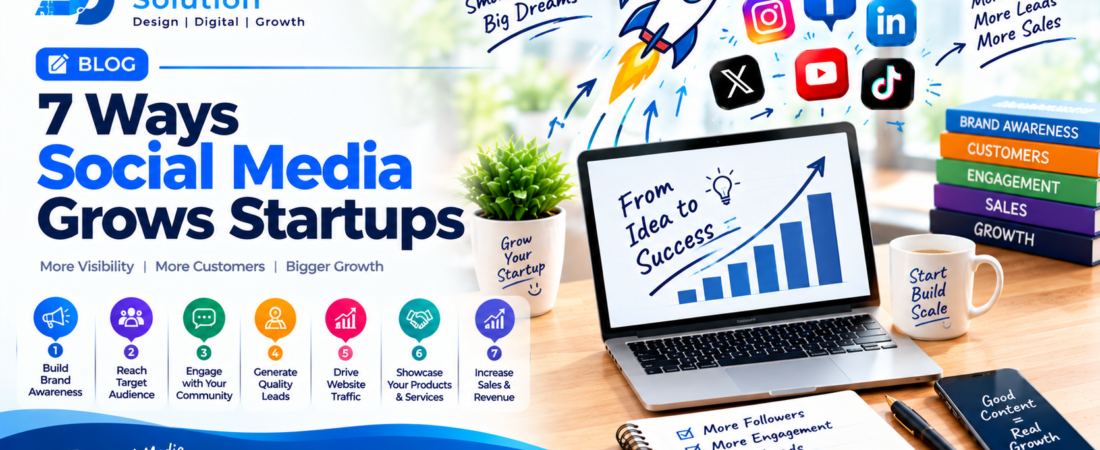
7 Ways Social Media Grows Startups
This WordPress-ready article is designed for your digital marketing website, with a startup-focused topic, Rank Math SEO settings, clear headings, practical examples, FAQs, and a call to action for SJ Digi.Tech Solution.
The content is structured for readability and search intent. Google recommends creating helpful, people-first content rather than writing only to achieve an SEO score or a specific word count.
1. Rank Math SEO settings
7 Ways Social Media Grows Startups: A Complete Guide
7 Ways Social Media Grows Startups
social media for startups
social media marketing for startups
startup growth strategies
social media brand awareness
startup lead generation
digital marketing for startups
Discover 7 ways social media grows startups, from building brand awareness and engaging customers to generating leads and increasing sales.
social-media-for-startups
Digital Marketing
Startups, Social Media Marketing, Business Growth, Digital Marketing, Lead Generation
You can enter the SEO title, meta description, and focus keyword in the Rank Math panel within the WordPress editor.
2. Complete blog article — ready for WordPress
7 Ways Social Media Grows Startups: A Complete Guide
Starting a new business is exciting, but growing a startup can be challenging. Many startups have limited marketing budgets, small teams, and strong competition. To attract customers and establish a recognisable brand, founders need effective ways to communicate their value and reach the right audience.
This is where social media for startups can make a difference. Platforms such as Instagram, Facebook, LinkedIn, and YouTube allow businesses to introduce their products, share useful content, communicate with customers, and build an online presence.
However, successful social media marketing involves more than creating an account and publishing occasional posts. Startups need a clear strategy, valuable content, consistent communication, and a way to measure results.
In this guide, we explore seven practical ways social media grows startups, along with examples and tips to help new businesses strengthen their digital presence.
What Is Social Media Marketing for Startups?
Social media marketing for startups is the process of using social media platforms to promote a new business, connect with potential customers, increase brand awareness, and support business growth.
Startups can use social media to introduce their products, demonstrate their expertise, share customer feedback, answer questions, and direct interested people to their websites.
There are two main approaches:
Organic social media marketing: Publishing posts, videos, stories, and educational content without paying for distribution.
Paid social media marketing: Running advertisements to reach selected audiences and promote specific offers, products, or services.
Both approaches can support startup growth. Organic content helps businesses develop their voice and relationships with followers, while paid advertising can provide additional reach when campaigns are carefully planned.
The best approach depends on your business model, audience, budget, and goals.
Why Is Social Media Important for Startups?
A startup needs to establish trust and help potential customers understand what makes its offering useful. Social media provides an accessible channel to communicate this information.
Instead of relying entirely on traditional advertising, startups can publish educational content, demonstrate their products, interact with audiences, and learn from customer feedback.
Social media can also help founders test marketing messages before investing heavily in campaigns. Questions, comments, website visits, and enquiries may reveal what customers want to know.
When used strategically, social media can support customer discovery, brand development, lead generation, and long-term business relationships.
7 Ways Social Media Grows Startups
1. Builds Brand Awareness and Online Visibility
The first challenge for many startups is getting noticed. Potential customers cannot consider a business if they do not know it exists.
Social media gives startups opportunities to introduce their brand to relevant audiences through posts, videos, stories, and advertising.
A consistent online presence can help people recognise your business name, understand your services, and remember your brand when they need a solution.
How startups can build brand awareness:
Create professional social media profiles with accurate business information.
Use consistent brand colours, fonts, logos, and messaging.
Publish educational and informative content.
Share product demonstrations and behind-the-scenes updates.
Participate in relevant industry conversations.
Collaborate with suitable creators or complementary businesses.
Use paid advertising when it supports a clear objective.
For example, a startup offering website design can publish posts explaining mobile-friendly design, website speed, and the importance of a professional online presence. These topics introduce the business while helping potential customers understand its expertise.
Startups should focus on reaching the right audience rather than simply collecting followers. A smaller audience that genuinely needs your service can be more valuable than a large audience with little interest in your offering.
Practical tip: Create three to five content topics that reflect your expertise, customer problems, and services. Publish useful content around these themes consistently.
2. Reaches Target Customers More Effectively
Social media helps startups communicate with audiences who are likely to be interested in their products or services.
Different platforms attract different communities and support different content formats. Choosing suitable platforms helps a startup focus its limited time and resources.
For example:
Instagram: Useful for visual products, creative services, Reels, and brand storytelling.
Facebook: Can support local business promotion, community engagement, and advertising.
LinkedIn: Often useful for B2B startups, professional services, and business networking.
YouTube: Suitable for tutorials, product demonstrations, educational videos, and detailed explanations.
Pinterest: Can support visual discovery for suitable product categories and creative businesses.
Before choosing a platform, identify your ideal customer. Consider their needs, location, interests, buying behaviour, and preferred ways of discovering new businesses.
A startup selling software to companies may prioritise LinkedIn and educational website content. A startup selling handmade products may benefit more from visual platforms that showcase product details.
Avoid spreading your efforts across every platform immediately. Start with one or two that match your target audience, develop a consistent publishing process, and expand when you have the resources.
Practical tip: Interview a few potential customers and ask where they discover businesses, what information they need before buying, and which questions they want answered.
3. Generates Leads and Sales Opportunities
One of the most valuable ways social media grows startups is by creating opportunities to generate leads.
A lead is a person or business that expresses interest in your product or service. Social media can help attract these prospects and guide them towards an enquiry, consultation, registration, or purchase.
Startups can generate leads through organic posts, educational videos, relevant offers, advertising campaigns, messaging channels, and website landing pages.
A simple social media lead-generation process:
Identify a specific customer problem.
Create useful content that addresses the problem.
Present your product or service as a relevant solution.
Add a clear call to action.
Direct interested users to a suitable website page, lead form, or messaging channel.
Respond to enquiries and qualify potential customers.
Track which activities produce relevant leads and sales.
For example, a startup providing digital marketing services could publish a guide about improving local business visibility. The post could direct readers to a service page where they can request a consultation.
Paid social media campaigns can also help startups reach selected audiences. However, campaign results depend on the offer, audience, creative quality, budget, and follow-up process.
Do not measure success only by the number of enquiries. Review whether leads match your target customer profile and whether they progress towards becoming paying customers.
Practical tip: Use a dedicated landing page for important campaigns. Explain the benefits clearly, provide relevant proof, and make the enquiry process simple.
4. Builds Customer Trust and Stronger Relationships
New businesses often need to establish credibility before customers feel comfortable purchasing from them.
Social media provides opportunities to communicate openly, answer questions, share useful information, and demonstrate how a business works.
Consistent and honest communication can help potential customers understand your values and services.
Startups can build trust by:
Responding to comments and messages professionally.
Sharing accurate product and service information.
Publishing genuine customer testimonials with permission.
Demonstrating products or services through videos.
Explaining common customer problems.
Sharing behind-the-scenes content.
Addressing concerns honestly and respectfully.
For example, a new website development company can publish examples of its design process, explain how websites are made mobile-friendly, and answer common questions about maintenance.
This type of content helps customers understand the service before contacting the business.
Startups should avoid fake testimonials, exaggerated promises, and misleading claims. Trust develops through reliable communication and consistent customer experiences.
Customer feedback can also reveal improvements that need to be made to your products, services, or buying process.
Practical tip: Create a list of the ten questions customers ask most frequently. Turn these questions into educational posts, short videos, or website FAQs.
5. Supports Cost-Effective Marketing
Many startups cannot afford large marketing campaigns during their early stages. Social media provides flexible options for promoting a business while working within available resources.
Organic social media marketing allows startups to publish content without paying for advertising distribution. Although creating content and managing accounts still require time and effort, it can be a practical starting point.
Paid advertising provides another option when the startup is ready to invest in reaching a larger or more specific audience.
For example, a local startup could test an advertisement promoting a service to people in its relevant service area. A software startup might test different messages aimed at businesses that could benefit from its product.
How startups can manage social media marketing costs:
Set clear marketing objectives before spending money.
Start with a realistic and affordable budget.
Create reusable content around important customer questions.
Repurpose suitable blog content into posts and videos.
Test different messages and creative assets systematically.
Track qualified leads and conversions.
Review performance before increasing advertising spend.
Startups should remember that low-cost marketing does not automatically mean effective marketing. A campaign that generates many irrelevant clicks may provide less value than one that attracts a smaller number of qualified prospects.
Compare your marketing spending with the quality of enquiries, sales opportunities, and customer acquisition costs whenever reliable data is available.
Practical tip: Start by testing a small number of content ideas organically. Use audience responses to inform future campaigns, but validate advertising decisions using proper campaign data.
6. Drives Website Traffic and Supports SEO
Social media can introduce people to your website, where they can learn more about your products, services, pricing, and business story.
For startups, a website provides a central place to present detailed information and convert interested visitors into enquiries or customers.
You can direct social media users to:
Educational blog articles.
Product pages.
Service descriptions.
Landing pages for specific offers.
Case studies and project portfolios.
Contact forms and consultation pages.
For example, a startup publishing content about digital marketing can share a blog post explaining how businesses use social media to generate leads. Readers who want more information can visit the website and explore relevant services.
Social media and search engine optimisation can complement each other. Helpful content shared on social media may attract visitors, encourage sharing, and help more people discover your website.
However, social media likes and shares should not be treated as a direct guarantee of higher Google rankings. SEO requires its own strategy, including useful content, accessible website pages, relevant links, and a positive user experience.
Make sure your website works well on mobile devices, loads efficiently, and clearly explains what visitors should do next.
Practical tip: Add relevant links to your social media profiles and include a clear call to action in posts that are designed to attract website visitors.
7. Provides Customer Insights and Helps Startups Improve
Startups often need to learn quickly about their target market, customer needs, and product positioning.
Social media provides opportunities to observe customer questions, gather feedback, and evaluate how audiences respond to different messages.
These insights can help founders improve their content and make more informed marketing decisions.
For example, a startup may publish several posts about its product features and discover that customers are most interested in saving time. The business can use this feedback to explain that benefit more clearly in future content.
Useful performance metrics include:
Reach: How many unique accounts saw your content.
Engagement: Likes, comments, shares, and saves.
Link clicks: How many users clicked a link.
Website conversions: How many visitors completed a desired action.
Qualified leads: How many enquiries match your target customer profile.
Conversion rate: The proportion of relevant visitors or prospects who completed a desired action.
Cost per lead: Advertising expenditure divided by the number of leads generated during the same period.
Select metrics that align with your goals. A startup focusing on awareness may prioritise reach, while a startup seeking customers should examine qualified leads, sales, and acquisition costs.
Review performance regularly and look for patterns rather than making major decisions based on one post.
Practical tip: Create a monthly report recording your strongest content, common customer questions, website traffic, lead quality, and planned improvements.
How to Create a Social Media Growth Plan for Your Startup
The seven strategies above work best when organised into a practical plan.
Step 1: Define Your Business Goals
Decide whether your priority is brand awareness, website traffic, lead generation, customer engagement, or sales. Choose measurable indicators to evaluate progress.
Step 2: Identify Your Ideal Customer
Describe the people or businesses most likely to need your offering. Research their challenges, interests, and preferred communication channels.
Step 3: Select Your Main Platforms
Choose one or two platforms that match your audience and business goals. Complete your profiles and ensure your branding and contact details are consistent.
Step 4: Build a Content Calendar
Plan educational posts, product demonstrations, customer questions, and promotional content. Create a realistic publishing schedule that your team can maintain.
Step 5: Engage With Your Audience
Respond to questions, acknowledge feedback, and share helpful information. Use conversations to learn more about customer needs.
Step 6: Test Advertising Carefully
If your budget allows, run targeted campaigns with clear objectives and appropriate conversion tracking. Evaluate lead quality before increasing spending.
Step 7: Review and Improve
Analyse your results monthly. Identify which content attracts relevant audiences, which channels produce qualified leads, and where customers leave the buying process.
This structured approach helps startups focus their efforts and make improvements based on evidence.
Common Social Media Marketing Mistakes Startups Should Avoid
Even a promising startup can waste time and resources by making avoidable marketing mistakes.
Posting without a strategy: Random posts may not support business goals. Create a content plan connected to your audience and objectives.
Trying to use every platform: Managing too many channels can reduce content quality. Prioritise the platforms that matter most to your customers.
Focusing only on followers: A large following does not guarantee sales. Track relevant engagement, website activity, qualified leads, and conversions.
Ignoring customer messages: Slow responses can create a poor customer experience. Assign responsibility for managing enquiries.
Using unclear calls to action: Tell users what to do next, such as visiting a service page, requesting a quotation, or reading a guide.
Spending on ads without measurement: Track campaign results and lead quality before deciding whether to increase your budget.
Expecting overnight growth: Building recognition and trust usually requires consistent effort. Review progress regularly and adjust your strategy.
Avoiding these mistakes helps startups use their marketing resources more effectively.
How SJ Digi.Tech Solution Can Help Startups Grow Online
At SJ Digi.Tech Solution, we understand that startups need a clear digital presence to introduce their offerings and connect with potential customers.
A coordinated digital marketing approach can combine social media management, creative design, paid advertising, lead generation, and website development.
Our services can include:
Social media account management.
Social media content and graphic design.
Meta Ads campaign planning and management.
Google Ads campaign management.
Lead-generation campaigns.
Website design and development.
Digital marketing strategy and performance reporting.
The right service mix depends on your startup’s objectives, audience, industry, and available budget.
Whether you are launching a new business or improving an existing online presence, a practical strategy can help you use digital channels more effectively.
Ready to grow your startup online? Contact SJ Digi.Tech Solution to discuss your social media marketing and digital marketing requirements.
Frequently Asked Questions
1. How does social media help startups grow?
Social media helps startups build brand awareness, reach potential customers, generate enquiries, communicate with their audience, and learn from customer feedback. Results depend on the strategy, audience, offer, and consistency of execution.
2. Which social media platform is best for startups?
The best platform depends on your business model and target audience. LinkedIn can be useful for many B2B startups, Instagram for visual brands, Facebook for community building and advertising, and YouTube for educational content and product demonstrations.
3. Can startups grow on social media without paid advertising?
Yes. Startups can begin with organic content, customer engagement, collaborations, and educational posts. Paid advertising can extend reach, but it is not essential for every business.
4. How often should a startup post on social media?
Choose a realistic schedule that allows you to maintain content quality. Start with a manageable frequency, monitor audience responses, and adjust according to your resources and objectives.
5. How can startups generate leads through social media?
Startups can publish helpful content, promote relevant offers, direct users to landing pages, use suitable lead forms, and respond to enquiries. Clear messaging and timely follow-up help improve the lead-generation process.
6. How much should a startup spend on social media marketing?
There is no universal budget. Consider your business goals, available resources, target audience, and the cost of reaching potential customers. Begin with an affordable plan and evaluate results before increasing spending.
7. How long does social media take to grow a startup?
The timeframe varies by industry, competition, audience, offer, and marketing execution. Some campaigns may generate early enquiries, while building brand recognition and customer relationships often takes sustained effort. No specific growth timeline can be guaranteed.
Conclusion
Social media can play an important role in startup growth by helping new businesses become visible, connect with customers, generate leads, promote their offerings, and learn from audience feedback.
The seven strategies in this guide provide a practical foundation: build brand awareness, reach the right customers, generate leads, develop trust, manage marketing costs, drive website traffic, and use analytics to improve your approach.
Start with clear objectives, choose suitable platforms, publish valuable content, and measure meaningful business results. You do not need to do everything at once. Consistent progress and informed decisions can help you develop a stronger online presence over time.
If you need help with social media management, Meta Ads, Google Ads, creative design, lead generation, or website development, SJ Digi.Tech Solution can help you explore a strategy suited to your startup.
Take the next step towards growing your startup online. Contact SJ Digi.Tech Solution to discuss your digital marketing goals.
3. Featured image SEO settings
Recommended featured image
Filename:
social-media-for-startups.webpAlt text: Seven ways social media helps startups grow their businesses
Image title: Social Media Growth Strategies for Startups
Placement: Near the beginning of the article
Format: WebP or another optimised image format
4. Internal links for your WordPress website
Add links to the following pages where the anchor text naturally fits the article.
Anchor text | Destination |
|---|---|
Social media marketing services | Social media services page |
Meta Ads management | Meta Ads service page |
Google Ads services | Google Ads service page |
Website design services | Website development page |
Lead generation services | Lead generation page |
Digital marketing services | Main services page |
You can also link to related articles on your website, including Top 10 Social Media Marketing Strategies and Top 5 Benefits of Social Media Marketing.
For an external reference, link to Google’s SEO Starter Guide, which explains how to make website content easier for search engines and users to understand.
5. Final Rank Math checklist
Ready to publish?
0/8 complete